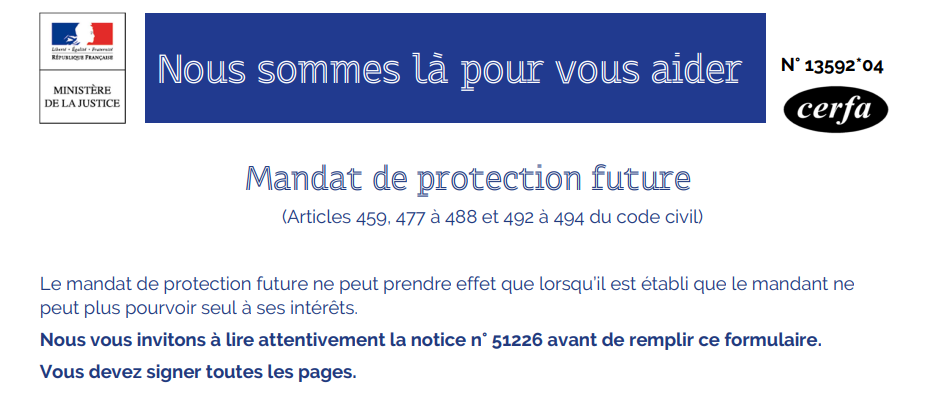
If you are searching for a lasting power of attorney in France, the legal mechanism you are looking for is called a mandat de protection future.
This article explains clearly how the private version works, who does what, how to add a substitute agent, and the most common mistakes to avoid.
This guide focuses only on the private form (Cerfa 13592*04) and its guidance notes (Cerfa 51226*05)
What Is a Lasting Power of Attorney in France?
A lasting power of attorney in France allows you to choose in advance who will manage your affairs if you lose mental capacity.
The French legal basis is found in the Civil Code (Articles 477–494), and the document used is called a:
Mandat de protection future
It allows you to organise:
- Protection of your person (health, daily life, housing)
- Protection of your assets (bank accounts, property, income)
You must register the completed form Cerfa 13592*04 with your local Tribunal court and pay the administration fee (currently 125€)
It only takes effect when:
- A doctor certifies that you have lost capacity.
- The mandate and certificate are presented to the court clerk.
- The justice clerk validates (stamps) the mandate.
Until then, it has no legal effect.
What Can the Agent Do Under the Private Version?
When creating a lasting power of attorney in France using the private form, the powers are limited to acts of administration.
The agent may:
- Pay bills
- Manage bank accounts
- Collect income
- Maintain property
- Handle routine administration
The agent may NOT:
- Sell property
- Make gifts
- Transfer ownership of assets
- Take major loans
These acts require court authorisation.
This is one of the most important limitations to understand.
The Agent: Who Manages Your Affairs
The agent (mandataire) is the person you appoint to act on your behalf once the mandate is activated.
You may appoint:
- One person for everything
- One person for personal matters and another for financial matters
The agent must:
- Act in your interest
- Respect your wishes and dignity
- Create an inventory of assets when the mandate starts
- Keep accounts
- Provide annual reports
They are legally responsible for mismanagement.
The Controller: Who Supervises the Agent
In the private version of a lasting power of attorney in France, appointing a controller is mandatory.
The controller:
- Receives annual financial accounts
- Receives written reports about personal protection
- Checks that the agent is acting properly
- Can alert the court if there is a problem
The controller does not manage assets and does not co-sign transactions.
Their role is supervision, not execution.
Adding a Substitute Agent (Strongly Recommended)
If you do not appoint a substitute agent and your main agent:
- Dies
- Refuses to act
- Becomes incapable
- Is removed
The mandate ends automatically.
That would mean applying to court for a protection measure, which defeats the purpose of planning ahead.
How to Add a Substitute
The private form does not always provide a printed box for this, so you must add a written clause in the appointment section:
“In the event that the above-named agent is unable or unwilling to perform the mandate, I appoint as substitute agent:”
Then include:
- Full name
- Date and place of birth
- Address
You must clearly state whether the substitute replaces:
- The agent for personal protection
- The agent for financial protection
- Or both
The substitute must:
- Handwrite their acceptance
- Date and sign
- Receive an original signed copy
Without their written acceptance, the replacement cannot function.
How Activation Works
A lasting power of attorney in France does not activate automatically.
The agent (or substitute) must:
- Obtain a medical certificate from an authorised doctor (less than 2 months old).
- Present the mandate and certificate to the court clerk at the Tribunal judiciaire.
- The clerk validates it.
Only after validation does the agent have authority to act.
Payment of the Agent
The mandate is presumed free unless you state otherwise.
You must specify separately:
- Payment for personal protection
- Payment for financial protection
- Payment for the controller
Options include:
- No payment
- Expenses only
- Fixed payment (clearly written by hand)
If nothing is written, the role is unpaid.
Common Mistakes When Setting Up a Lasting Power of Attorney in France
- Forgetting to appoint a controller.
- Not signing every page.
- Failing to add a substitute agent.
- Assuming the agent can sell property.
- Not obtaining handwritten acceptance from agents and substitutes.
- Leaving optional sections blank without writing “néant”.
These errors can prevent activation or cause serious delays.
When Does the Mandate End?
It ends automatically if:
- You recover capacity
- You die
- The agent dies (and no substitute exists)
- A judge replaces it with another protection measure
The agent must keep documents for five years after termination.
Is a Lasting Power of Attorney in France Right for You?
The private mandat de protection future is suitable if:
- You want to plan ahead without court involvement at the outset
- You trust your chosen agent
- Your situation does not require immediate property sales
It provides structure, legal clarity and oversight, while remaining relatively straightforward to set up.
You can download an English translation of Cerfa 13592*04 below:
If you need assistance completing the form correctly or structuring agents and substitutes properly, Help in France can guide you through the process step by step.
For more articles about life in France, visit our BLOG
Legal Disclaimer:
The services provided by Help in France consist solely of general information, guidance, and orientation based on personal experience.
Help in France does not provide:
- Legal advice
- Tax advice
- Financial advice
- Medical advice
Nothing discussed during calls or written follow‑ups constitutes professional advice as defined under French law. Clients remain solely responsible for decisions taken and actions performed following the guidance provided. Help in France shall not be held liable for outcomes resulting from the use or interpretation of information provided.