

May 2026 Heatwave in France – what you need to know before you head to the beach.
France has more than 5,500 km of coastline, thousands of monitored bathing areas, and some of the most famous beaches in Europe. But not all beaches are equal when it comes to water quality, safety, facilities or local rules.
Before you spread out your towel this summer, it is worth knowing what the latest 2026 rankings reveal.
La Belle Plage is an independent classification system based on official French bathing water data.
The 2026 French Beach Water Quality Rankings
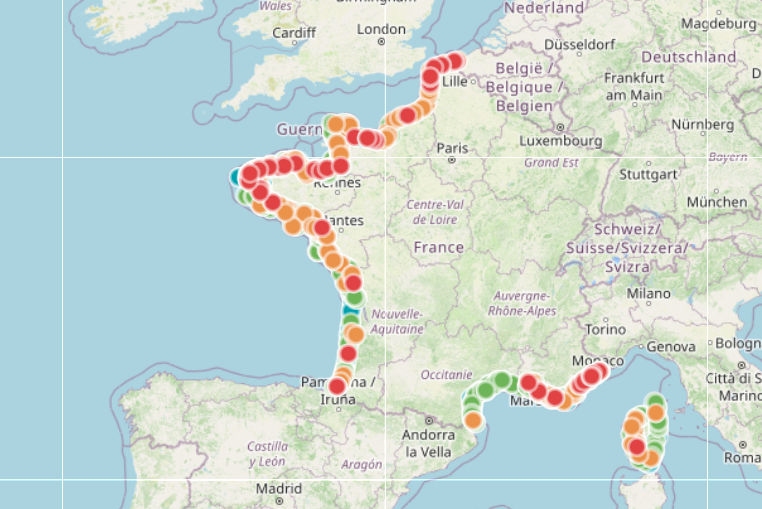
The 2026 edition of “La Belle Plage” analyses 1,871 monitored French beaches using four years of official water testing carried out by regional health authorities (ARS). (Eau et Rivières de Bretagne)
The beaches are grouped into four categories:
- Recommended
- Low risk
- Discouraged
- Avoid
According to the 2026 results:
- 567 beaches were rated “Recommended”
- 881 beaches were classed as “Low risk”
- 353 beaches were considered “Discouraged”
- 70 beaches were labelled “Avoid”
The system focuses specifically on the health risks for swimmers, especially pollution linked to bacteria such as E. coli and intestinal enterococci.
Unlike the official European classification, La Belle Plage uses a stricter interpretation of the same public data to better reflect short-term contamination risks for bathers.
How French Beach Water Is Tested
In France, bathing water is monitored during the summer season by regional health agencies (ARS). Between 4 and 14 water samples are typically taken between June and September.
The official EU system classifies beaches as:
- Excellent
- Good
- Sufficient
- Insufficient
However, campaigners behind La Belle Plage argue that the European system can sometimes mask occasional but significant pollution events.
Heavy rain is often a major factor. After storms, agricultural runoff, overloaded drainage systems and wastewater discharges can temporarily increase bacterial contamination.
A sensible local rule in France is:
Avoid swimming for 24–48 hours after heavy rainfall, especially near river mouths or urban beaches.
The Good News: Most French Beaches Are Still Safe
Despite the headlines, overall bathing water quality in France remains high.
Official government data showed that 90.5% of French bathing sites in 2024 were rated “excellent” or “good”. (notre-environnement)
Many Atlantic, Mediterranean and Breton beaches continue to achieve excellent results year after year, particularly in areas with strong environmental management and lower urban pollution pressure.
French Beaches: Water Quality & Rules
Beach rules in France vary depending on the commune, but there are some common regulations visitors should know.
Dogs
Many beaches ban dogs during the summer season, especially between June and September. Some allow dogs early in the morning or late evening, while others have dedicated dog beaches.
Always check local signage before arriving with pets.
Smoking
An increasing number of French beaches are becoming “non-smoking beaches” (“plages sans tabac”). These are particularly common near family resorts and tourist areas.
Topless Sunbathing
Topless sunbathing is widely accepted on most French beaches and is generally treated as normal behaviour. (Reddit)
Full nudity, however, is usually only permitted on officially designated naturist beaches.
Wild Camping and Sleeping on Beaches
Sleeping overnight on beaches or dunes is normally prohibited. Coastal authorities are particularly strict in protected natural areas.
BBQs and Fires
Open fires and disposable BBQs are usually forbidden due to fire risk, especially in southern France during summer.
Safety Flags
French beaches commonly use coloured safety flags:
- Green = safe to swim
- Orange/Yellow = caution
- Red = swimming prohibited
- Purple = dangerous marine life or pollution warning
On supervised beaches, lifeguards (“MNS” — Maîtres-Nageurs Sauveteurs) usually operate from June to early September.
Blue Flag Beaches (“Pavillon Bleu”)
Another important classification in France is the Pavillon Bleu environmental label.
This award recognises beaches and marinas meeting standards for:
- water quality
- environmental management
- waste control
- accessibility
- public information
A Blue Flag beach is not automatically the cleanest beach in France, but it generally indicates strong environmental standards and good facilities.
How to Check a Beach Before You Go
- Independent rankings like La Belle Plage
- the French government site: Baignades Santé France
This is particularly useful after storms or periods of heavy rain.
French beaches remain some of the best in Europe, but the 2026 classifications are a reminder that water quality can vary considerably from one location to another — and even from one week to the next.
A quick check before heading out can help you avoid polluted water, choose cleaner swimming spots, and enjoy the coast with more confidence.
And in true French style, the best beach is usually the one where the water is clean, the lunch is long, and nobody is in a hurry.